Saturday, May 14, 2016

Five Hottest Trends In Pet Nutrition


After suffering through seven flights and taking in three trade shows, I got more than I bargained for. Not only did I catch a killer cold on a flight to sin city, I was walloped with information overload on the issue of pet nutrition.

Not that it should be any surprise to anyone, but pet nutrition is a huge growth sector within the pet industry, a fact that even the most casual observer couldn’t ignore if she tried. And if the observer happens to be a veterinarian on the lookout for trends … watch out! This year there are more moving parts in the world of pet foods than I was expecting.

Luckily, I’ve digested most of them here for your consideration:
#1 Formula proliferation

It’s like the manufacturers’ brands all had babies this year. Every year it seems as if there are more formulas out there than ever before, but this year the pet food aisle appears especially crowded. Global Pet Expo had my head swimming with all the new foods on offer.

The year of the “grain-free” pet food

Food Coupons for Pets at Petsmart.com

Up To $5 OFF On Blue Buffalo Dog Food + FREE Shipping On $49+
Get Up To $5 OFF On Blue Buffalo Dog Food + FREE Shipping On $49+. Buy now!

$4 OFF On Select Bags Of Royal Canin Dog Food + FREE Shipping On $49+
Get $4 OFF On Select Bags Of Royal Canin Dog Food + FREE Shipping On $49+. Shop now!

See more petsmart coupons, Petsmart grooming coupons 2016 now

“Grain-free” is everywhere! Never have I seen so many foods proclaim their freedom from seeds and cereals. Manufacturers laud their granular liberty on decorative gold seals, beauty queen-style banners, and pricey TV commercials, alike.

The idea is threefold:
Grains = allergens. And while that’s often true, that isn’t strictly so. After all, given sufficient exposure, pets can develop allergies to turnips and beets as easily as they can to corn and wheat.
Pets don’t need so many grains. Which, again, is kinda true. But if a manufacturer substitutes other simple carbs instead, that doesn’t much help a carnivore out, does it?
Because GMOs (Genetically Modified Organisms) suck. The issue has been hotly debated. But let it suffice to say that those who don’t appreciate genetically modified plants in their pet foods would do well to stay away from corn, wheat, and soy (unless specifically listed as “non-GMO” on the label).

All hail the potato!
#3 “Natural” ingredients replace artificial flavors and preservatives

You may know them as BHA, BHT, and ethoxyquin. These synthetic preservatives have long been regarded as suspect by those concerned they might lead to adverse events.

While reports of these to the FDA were not reproducible in the laboratory at the concentrations found in pet foods, it’s nonetheless clear that pet owners are willing to pay a premium for pet foods that employ natural substitutes like rosemary extract, Vitamin E, and other antioxidants.
#4 “By-products” get some definition

Though pet food manufacturers and animal nutritionists have always claimed that by-products are perfectly wholesome ingredients, pet owners have often balked. And, honestly, I can relate. After all, who wants a black box menu item as a stand-in for who-knows-what kind of fat, protein, or carbohydrate.

Maybe I’m being unnecessarily picky, but to me it only makes sense that if chicken liver is what’s in there that it get a mention. Calling it by-product means that one day it might be beef heart and the next it could be something else. Why wouldn’t I want to know? Do they think we don’t like the sound of specific organ meats?
#5 Clarity and transparency are IN … confusing terminology is OUT

Definitions matter. And pet owners are smart enough to question them. No longer is it good enough to say your food is “natural,” “human-grade,” “organic” or “holistic.” Consumers are looking out for the following clarifications:
“Natural” must be described as per #2, above.
As it carries no legal definition, “human-grade” requires an explanation as to how the manufacturer has met safety and sanitation standards equivalent to those required for human foods.
By USDA standards, “organic” has a very specific definition. Which explains why consumers increasingly seek the familiar seals third party auditors offer compliant manufacturers.
“Holistic” is not a legal term. It’s not even a nutritional term, per se. It merely serves to suggest that a certain philosophy is at play. And some consumers (like me) are starting to get a little exasperated at the murkiness of terms like this.

Give me clarity, I say … or I’ll pick another brand.

These are the current trends I’ve picked up on at this year’s trade shows, but I’m also closely watching some new ones on the horizon. For example, the recent emergence of the private veterinary nutritionist has piqued my interest, as has the nascent rise of the humanely/sustainably sourced designation.

How about you? What have you found waxing or wanting in the world of pet nutrition?

- See more at: http://www.embracepetinsurance.com/pet-care/trends-in-pet-nutrition-2013#sthash.q7k4DRwT.dpuf

Pet Care: Preparing Pets for a Baby


Bringing home a baby is a huge adjustment for both people and our pets. If your pet has spent limited time with a baby or children, or your pet has been your only “child” for some time, many of the adjustments may be upsetting. Take action now to avoid additional stress and make this time of transition as smooth as possible.

Do not try to love/snuggle/play with your pets as much as possible right now! While it may sadden you to think your time with your pets will soon be shared, or significantly reduced, showering them with extra attention now sets them up for an even bigger letdown when baby arrives.

If you have neglected to teach your dog any commands, it is time to buckle down and get serious with the training. It will be very useful to have a dog that can obey the bare minimum commands of sit and stay, along with knowing not to jump up on people. Dogs can be dangerous underfoot when carrying a little one, so teaching your dog a command to get back can also be a good idea.
If you currently sleep with your pets and plan on having your baby sleep in your room for any length of time, kick your pets out in advance. You can’t supervise while you are asleep. A baby may be viewed by your cat as a soft, warm spot to sleep, which could be deadly for a newborn or infant. If you choose to keep your dog in the room at night, make sure your bassinet is secure and locked in place and that your dog cannot get into it.

Review the steps to avoid bites between pets and children pronto and learn how to recognize signs of canine stress. Your cat will be stressed; you can just assume that.
Change up their routine. If your pets are on a schedule, it’s time to break out of it. If they are used to being fed at 7 am followed by a brisk walk, try altering that time and order. Babies bring chaos; acclimate your pets now to reduce stress.

If you don’t use your dog crate regularly, start doing so now. Just because your dog is able to wander free and guard the house unsupervised now does not guarantee he won't rebel when baby arrives and diverts attention. Avoid the additional stress of destroyed objects and introduce the crate in small increments. While this may seem unnecessary, skipping this step risks that. The crate will also be a safe haven for the dog once baby arrives.

Introduce your pets to baby objects, sounds, and smells. Some easy ways to do this are simply setting up the nursery and having baby objects out in the home. Play a YouTube video of babies crying for your pets with regularity or consider playing a CD of baby lullabies if you will be using one. Some people find it useful to carry a doll around and initiate the rules you will enforce when your real baby arrives. You can even have someone bring home a blanket your baby was swaddled in at the hospital before you are discharged so your pets can acclimate to the smell.

Arrange for help so your pets won’t be neglected. You will want at least a couple of people lined up to care for your pets when you go into labor, as you may not be able to get in touch with everyone. Once home, see if you can arrange for a friend to take your dog for a daily walk or provide a petting session for your cat for a few days while you and baby get adjusted. Look into doggie daycare as another option.

Don’t wait until month nine (or right before the estimated arrival of your adopted little one) to make these changes. Due dates and adoption dates are only estimates and constantly changing. The more time you spend prepping your pets for baby's arrival now, the less time you will have to spend troubleshooting problems after your little one arrives.

Sadly, many parents give up their fur children after the arrival of human ones because of behavior problems that could have been largely avoided. What other tips do you have to offer expecting parents?

Coupons for Pet at petsmart.com: PetSmart Coupon Up To 30% OFF Sale Items + FREE Shipping on orders of $49 or more! Go through this link and save!

What to Do with Pets When Kids Go Back to School


Kids aren’t the only ones who might be sad to say goodbye to summer and hello to school--your pets may have a hard time adjusting too! Going from having the kids around to play with all day to a quiet house can be a little challenging for some pets. They may get lonely and bored, or lost in the shuffle of a busy family’s schedule. Here are some recommendations for keeping your pets active and tended-to during the school year.

Coupon for Pet: Save Up To 30% OFF PetSmart Special Offers + FREE Gifts + FREE Shipping on orders of $49 or more! Redeem this coupon and save! Click here

SMART TOYS

Smart toys are designed to make pets “work” for their treats or meal, and are especially great if your pet is home alone for extended periods of time. You can find everything from a basic kibble-dispensing ball to advanced puzzles that require your pet to move pieces around in a certain order to find hidden treats. There are many options on the market, so do some research to find the toys that will work best for your pet.

Bonus tip: Keep a few different smart toys on hand, rotating them every week or two, to keep your pet’s interest fresh!

TURN A TRIP TO SCHOOL INTO A SHARED ADVENTURE

Does your pet love to get out of the house? Whether driving or walking, you might consider including him in the daily trips to and from school.

Walking: If your dog is good with crowds and commotion, bring him along when you walk the kids to school or the bus stop. Then, to give him a real workout, add a few blocks (or miles!) on the way back.

Ariana of Clovis, CA has two boys, ages 9 months and 4, as well as 1 dog, 2 cats, 4 fish, and 1 snake. She remembers, “growing up, we always walked the dogs to the bus stop and back in the morning and afternoon; they loved the attention from the other kids. When my kids are ready for elementary school, I plan to walk the dog to school and back (since parking is such a nightmare!).”

Bonus tip: Plan a route that intersects your favorite coffee shop or pet store to pick up treats for you and your pup!

Driving: If your pet enjoys car rides, let him come along occasionally when dropping the kids off, picking them up, or when you’re headed out to run some errands. Just remember, never leave your pet in the car unattended. Only take him along if you can stay together for the duration of the outing.

Elaine of Long Beach, CA, mother to two kids ages 1 and 5 and 2 dogs, says, “I try including [my dogs] whenever possible. They love going to school each morning and obviously look forward to it. It’s clear that ride is one of the best parts of their day.”

DOGGY DAYCARE

This is a great option for extended care (and advanced wearing-out). Take your pet for a half or full day of romping and socializing while everyone else in the family is occupied with school and work. What’s great about doggy daycare is that your dog will get little (if any) sleep while he’s there because he’s having so much fun. That means he’ll probably come home and pass out... and maybe even still be tired the next day!

GET A BUDDY FOR YOUR PET

This might sound like a strange (and possibly crazy) suggestion if you feel pressed for time with one pet, but adding another animal to the mix can really help. The pets can keep each other company, play with one another, and teach each other good social skills and manners. As Amy of Inglewood, CA, mother of 2 teenagers and 2 cats, says, “Make sure that the animals have companions of their own--they get lonely, too. We have two cats, but when I owned only one, I used to leave a radio on when I was gone.”

DOG WALKERS

Hiring someone to walk your dog - or even just play with him while you’re at work or getting stuff done around the house - can go a long way. If using a professional service every day isn’t in the budget, try a long session once or twice a week, or if your pet is easily managed, put word out to local college students or neighbors to see if they’d like to help. The key is to find a helper or service that matches your pet’s need. If you have a big, active dog, you want someone who can take him on long, strenuous hikes to wear him out. If you have a quiet, little cat, maybe he’d prefer someone to brush and pet him quietly for a half hour.

CARVE OUT TIME TOGETHER

You don’t always have to take your pet on grand adventures to keep him happy. Much like human kids, pets just want to be around you and know they are loved!

Ariana says, “when it's just me and the pets, I'll take the dog for an early run, or lay on the couch and cuddle with the cats after cleaning the house. I do my best to include them as much as the kids. And the kids do the same.”
ENROLL IN A CLASS OR HAVE YOUR OWN OBEDIENCE LESSONS

Just like your kids, your pets thrive when they have mental stimulation. Consider joining a local group or class where your pet can learn anything from basic obedience to agility! Learning new skills and having goals to achieve make your pet more confident and happy, and the brainpower he has to expend tires him out as well! If a group class doesn’t fit your schedule or budget, you can always work one-on-one with your pet. Even spending ten minutes twice a day practicing commands can make a big difference. The great bonus? You get a well-mannered pet out of it!
GET YOUR KIDS INVOLVED

It’s also never too early to teach the kids how to care for your pets. Even young children can scoop food into a bowl or tell you if the water needs refilling, while older kids can take complete responsibility: “I make sure the kids take extra time in the morning to double check that their animals have clean, fresh water and food,” says Amy.

When it’s time for homework, include the pets! Your kids might find it nice to have some quiet company to practice their reading, math, or language skills with. This works especially well with kids who are shy or in need of a confidence boost! Play time with pets can also be a great incentive, so you can use them as a motivator/reward (ie. “if you finish your spelling homework, you can play fetch with Harley for 5 minutes”).- See more at: http://www.embracepetinsurance.com/pet-care/what-to-do-with-pets-when-kids-go-back-to-school#sthash.unvwzM1U.dpuf

Saturday, May 7, 2016

Why you shouldn’t feed your Pet a Supermarket Diet

Buying pet food from the supermarket is quick, convenient and often cheaper. Unfortunately, it's also a lot less healthy and nutritious for your pet, and may cause serious and expensive health problems in the long run.

We know that what we put into our own bodies has a direct impact on how healthy we feel and our resistance to disease. If you survive on a diet of fast food and chocolate, your health will deteriorate and odds are so will your teeth – probably at the same rate that your waistline will increase.


The same goes for our pets. Feeding your cat or dog a bad quality diet is likely to lead to poor health, bad teeth and preventable illness.

The truth is that dogs and cats can survive on just about anything we feed them. But will they thrive? Research shows that feeding a premium diet will help your pet live 30% longer, increase their quality of life AND save you money in the long run by improving their overall health.

It may sound like a huge generalisation, but for the most part supermarket foods are not that great for our pets. Simply buying a brand that is endorsed by your favourite celebrity does not guarantee its quality either!

A diet full of indigestible cheap fillers ends up mostly coming out the other end. That means more poo and flatulence, and less vital nutrients being absorbed by your pet’s body.

Pet nutrition has come a long way over the last ten years. Unfortunately, as a result, the collection of different brands, foods and feeding practices can be a little overwhelming. So what should you look out for when choosing what to feed your furry family member?

Good quality pet food should…
have meat as the first ingredient
include none (or very little) cheap fillers
use good quality ingredients
be based on sound nutritional research
be made by a reputable company

Get Up To $5 OFF On Blue Buffalo Dog Food + FREE Shipping On $49+ with Petsmart $5 off coupon. Buy now!

Should you feed your Pet a Grain Free Diet?


Grain free, hypoallergenic pet diets are becoming increasingly popular. Dr Eloise Bright discusses whether cats and dogs are allergic to grain, what causes food allergies, and whether you should buy your pet a grain free food.
The way our own bodies digest food is very different from cats and dogs.


Our pets’ stomachs are designed to eat some pretty disgusting things – like possum poo!

Dogs and cats have a very short transit time from eating to evacuation (less than 24 hours and as short as 6 hours), while for humans this can be up to 5 days, allowing for the digestion of more complex materials. That means dogs and cats lack the ability to process grains as efficiently as humans, so they need these in a form they can manage.

Cats are pure carnivores so need a high protein diet from animal sources.

Dogs are technically omnivores, and over time have developed the ability to process starch and foods that their wolf ancestor could not.

Are cats and dogs allergic to grains?


There are lots of different types of grains. Some include gluten, such as barley, rye, wheat and oats. Others are gluten free, like corn, sorghum and quinoa.

There is currently no definitive evidence to suggest that grain causes allergies in dogs or cats. Some pets may develop skin allergies due to corn, but the most common food allergies in pets are to beef, dairy, chicken and lamb, rather than grains.

How do I know if my pet has a food allergy?

Food allergies may cause diarrhoea, vomiting or weight loss, but also often show up in the skin. So if your dog licks his feet, gets frequent ear infections or an itchy bottom, the culprit could be a food protein like beef. Cats often develop itching around the head with their food allergies.

The only way to diagnose a food allergy is by doing a food trial. We recommend chatting to your vet about how to do this properly so you don’t waste time and money on a food that won’t help.

You will need to feed a novel (or new) protein   with a carbohydrate source like sweet potato. Or you could use a diet designed for food allergies like Royal Canin Hypoallergenic or Hills Science Diet Z/D.

So should I try grain free?

Certainly there is no harm in feeding your pet a grain free diet. However more importantly, you should be feeding your pet a good quality, well-known brand that you know has excellent safety records. So avoid those cheap supermarket foods and buy as good a quality as you can afford. But consult with your vet if you have any concerns with your pet’s digestive system or skin so we can help you get to the bottom of the problem.

FOOD COUPONS FOR PETS:

Up To $5 OFF On Blue Buffalo Dog Food + FREE Shipping On $49+
Get Up To $5 OFF On Blue Buffalo Dog Food + FREE Shipping On $49+. Buy now!
$4 OFF On Select Bags Of Royal Canin Dog Food + FREE Shipping On $49+
Get $4 OFF On Select Bags Of Royal Canin Dog Food + FREE Shipping On $49+. Shop now!

See more at here

ACTIVE PETSMART GROOMING COUPONS IN MAY 2016

ACTIVE PETSMART GROOMING COUPONS


Up To 30% OFF PetSmart Special Offers + FREE Gifts + FREE Shipping
Up To 30% OFF PetSmart Special Offers + FREE Gifts + FREE Shipping on orders of $49 or more! Redeem this coupon and save!

PetSmart Coupon Up To 30% OFF Sale Items + FREE Shipping On $49+
PetSmart Coupon Up To 30% OFF Sale Items + FREE Shipping on orders of $49 or more! Go through this link and save!

FREE Shipping on $49+ at PetSmart
Get FREE Shipping on orders of $49 or more. Valid within the contiguous 48 U.S. states and to military APO/FPO addresses! Offer Ends Soon!


Up To 50% OFF Treat of The Week + FREE Shipping W/ PetSmart Coupon
Get Up To 50% OFF Treat of The Week + FREE Shipping W/ PetSmart Coupon. Save now!

Up To $5 OFF On Blue Buffalo Dog Food + FREE Shipping On $49+
Get Up To $5 OFF On Blue Buffalo Dog Food + FREE Shipping On $49+. Buy now!

$4 OFF On Select Bags Of Royal Canin Dog Food + FREE Shipping On $49+
Get $4 OFF On Select Bags Of Royal Canin Dog Food + FREE Shipping On $49+. Shop now!

10% OFF Small Bags Of Instinct Raw Boost Kibble + FREE Shipping On $49+
Take 10% OFF Small Bags Of Instinct Raw Boost Kibble + FREE Shipping On $49+. No code needed.

Shipping at rate of $1 with Gift Card
Enjoy Shipping at rate of $1 with Gift Card. Enjoy now!!!!!!

Buy Online & Pick Up In-Store
Buy Online & Pick Up In-Store! Valid for a limited time at PetSmart!

Cat Health – Keeping Them Purr-fect

Hi Pet Blog Readers,
Please welcome guest blogger Lilly Sheperd!  Today she has a post that asks us to be proactive in regard to the health of our friendly felines.  She covers how important preventative maintenance can be for your cat and how crucial it is for them to engage in exercise and activity while also enjoying a good diet.  If you have any questions, comments or tips of your own for keeping your cats healthy please let us know in the comments section.  Thanks!
___________
Cats are extremely agile and active pets known for their curiosity. For this reason, many humans find they are easily humored by the feline species’ innate sense of independence, and enjoy spending time with these furry little beholders of big personalities.


It is no wonder, then, that cat owners want to do whatever it takes to help their animal companions live long and healthy lives. Promoting longevity in your pet is not achieved by any miracle cure, but rather results from consistent effort throughout an entire cat’s life. By combining a well-rounded preventative care regimen, an increase in the amount of exercise your pet experiences, and a boost to the nutritional value of your cat’s diet, you may be able to carry your pet through over a decade of play, laughter, and fun.

Preventative Care Starts Early: Preparing Your Pet for a Long and Healthy Life
One of the most important aspects of health maintenance for your cat is preventative medicine – and prevention begins the moment that a cat is born. Staying up-to-date on regular vaccinations, anti-parasitic medications, and other preventative treatments can severely reduce the risk of your beloved pet developing illnesses and diseases. Since regulations regarding what medicines are required of domesticated animals often change, consultation with your veterinarian on an annual basis is necessary to help you ensure that you stay in compliance with policy.

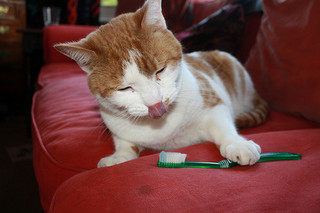
Picture uploaded to Flickr by Zabby Allen.
Another key facet of preventative care for cats ismaintenence of your pet’s dental hygiene – though it is often overlooked by pet owners. The process of taking care of your cat’s teeth and gums is relatively simple: with a small toothbrush and a pea-sized drop of toothpaste that is specially formulated for your cat’s mouth, gently massage the teeth and gum areas to remove plaque and any other buildup. Cats that are more finicky about the process of having their teeth brushed often can substitute crunchy dental health treats, designed to remove plaque as cats eat, for their brushing routine. Frequently serving crunchy dry food to your cat can also reduce the risk of buildup forming inside its mouth.

Achieving Regular Activity: Both Play and Exercise Are Critical to Cat Health
Nails
It is very important for cats to have access to toys and enough space for adequate play each day. Surely, stereotypes tell us that cats are fat, lazy, and lounge around all day – and veterinarians agree that it is healthy for cats to have relaxation time as well. However, play can help build the strength of your pet’s muscles, and staying active can prevent troubles with your cat’s joints and ligaments over time. It is far easier for active cats to maintain a healthy weight through engagement in exercise than simply through calorie restriction.

A Nutritious Diet: A Central Part of a Cat’s Healthy Lifestyle
Perhaps the most important part of a pet’s preventative care routine is the maintenance of a healthy, balanced diet. A cat should have a daily diet of healthy cat food. The ideal cat food brand has a high level of animal proteins, and is chock-full of vitamins and minerals that promote your cat’s health. Look for trusted brands that, unlike generic brands, have certification stamps of their safety, and use meats, carbohydrates, and other ingredients that are natural and of high quality. Access to a fresh bowl of clean water is also a key part of maintaining bodily health for a cat.  Get FREE Shipping on orders of $49 or more. Valid within the contiguous 48 U.S. states and to military APO/FPO addresses! Offer Ends Soon! Click here

Did you know that over 54% of the cat population in the United States is overweight? Veterinarians warn that extra weight is an early indicator of disease, and can lead to kidney failures, heart disease, and other kitty illnesses over time. Weight management is based in part on portion control, but also depends upon the food’s nutritional quality. For more information about what your pet’s particular dietary needs are, consult your veterinarian.